Coffee isn't the villain (but read the fine print)
I'm at Chill Cawfee finishing my second Nitro Cold Brew, trying to convince myself that reading a scientific study about coffee counts as a valid reason to order a second coffee. Anyone else negotiate with themselves like this, or is that just a me problem?
If you've ever felt a flicker of guilt pouring that second cup, I've got good news. The American Heart Association just put out a major new statement on caffeine and heart health, and the takeaway is refreshingly simple: coffee is not out to get you.
For years, coffee has lived in this weird cultural purgatory. One year it's a heart risk, the next it's a superfood, and most of us just kept drinking it and hoping for the best. So let's clear the air.
What the AHA actually found
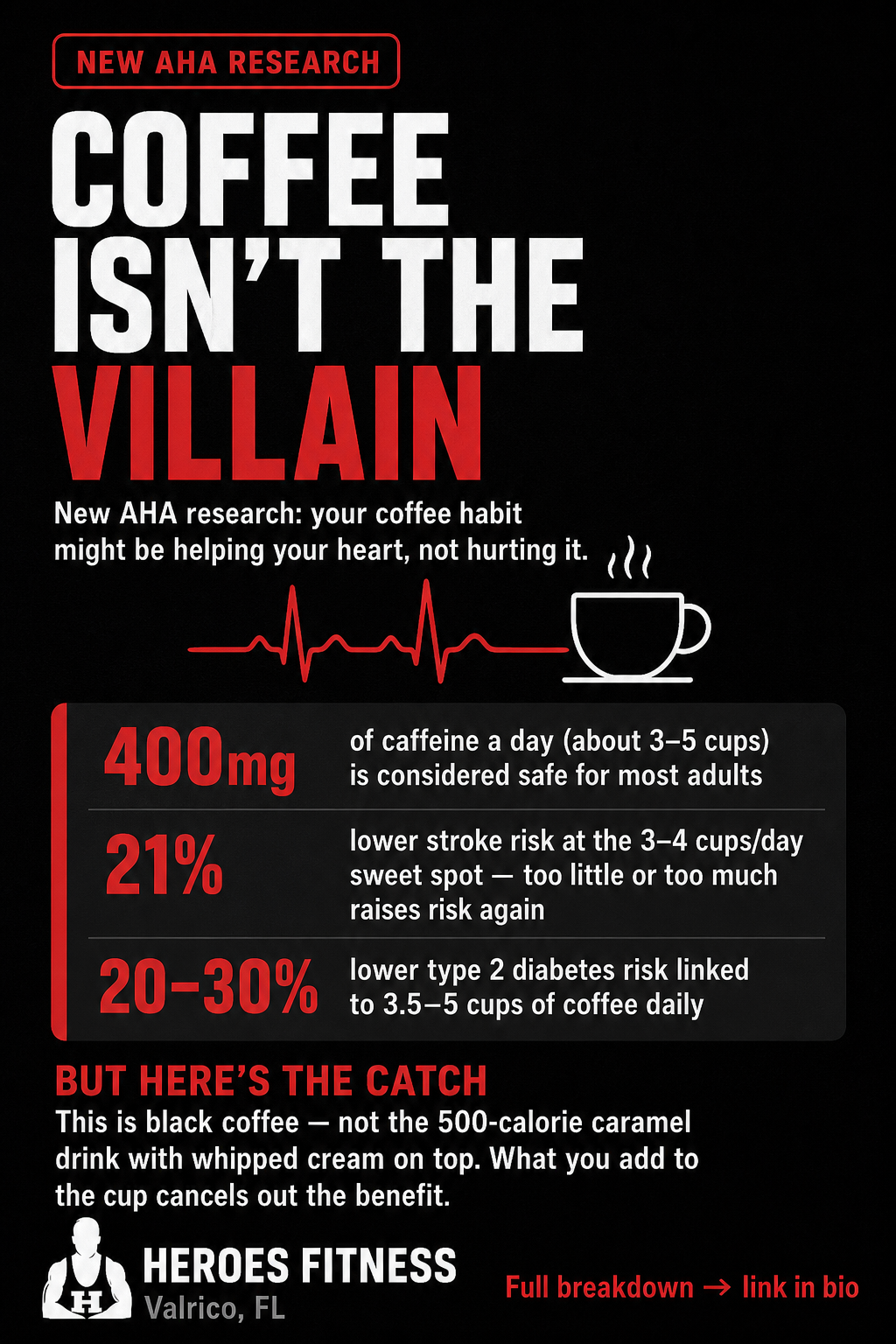
The review, led by cardiologist Gregory Marcus and a team of researchers, pulled together decades of data on caffeine and cardiovascular health. The conclusion: for most adults, drinking up to about 400 mg of caffeine a day — roughly 3 to 5 standard cups of coffee — is not just safe, it's associated with a lower risk of some serious stuff. We're talking reduced risk of stroke, heart failure, atrial fibrillation, high blood pressure, and type 2 diabetes.
One study cited in the review found people drinking 3 to 4 cups a day had a 21% lower stroke risk compared to those drinking less. Another found a 20-30% lower risk of type 2 diabetes in regular coffee drinkers. Not a fluke, a pattern.
Coffee also isn't just caffeine in a cup. It's loaded with other compounds that seem to bring some antioxidant and anti-inflammatory benefits along for the ride, which is part of why even decaf shows some of the same positive associations. So no, it's not purely a caffeine story.
Coffee, meet your redemption arc.
I just re-read that sentence and realized I've now written the word "coffee" so many times it's stopped looking like a real word. Coffee. Coffee coffee. Yeah, that's broken now. Moving on.
But here's the fine print (and it matters)
Before you print this out and staple it to your fridge as scientific permission to live at the Starbucks drive-thru, a few things:
First, the researchers themselves are clear that most of this evidence comes from observational studies, not tightly controlled experiments. That means we're looking at strong patterns and associations, not an ironclad "coffee causes better health" guarantee. Correlation and causation are still getting to know each other here.
Second, everyone processes caffeine differently. Your age, medications, other health conditions, and genetics all affect how your body handles it. What's a perfectly reasonable amount for your coworker might not sit the same way with you. There's no universal green light, just a generally reassuring one.
Third, and this one's important: this is about coffee, not energy drinks. The statement specifically calls out that these findings shouldn't be extrapolated to energy drinks or caffeine shots, which come with their own set of cardiovascular concerns at high doses. Different animal entirely.
Now for the part we really need to talk about: what you're putting IN the coffee
Here's where I have to put my coach hat back on.
The AHA statement is about coffee. Black coffee, or coffee with modest amounts of milk, brewed the normal way. It is not a statement about the 550-calorie caramel situation with whipped cream and a drizzle that some of us call "coffee" but is honestly just dessert with a caffeine delivery system.
This is the same conversation we had about carbs a few weeks back. The food (or in this case, the drink) isn't the problem. What we build around it is where things go sideways. A cup of coffee is roughly 5 calories. Add heavy cream, flavored syrup, whipped topping, and sugar, and you can easily be looking at 300-500 calories before 9am, several days a week, without ever feeling like you "ate" anything.
So enjoy your coffee. Genuinely, drink it without the guilt trip. Just don't let a legitimate heart-health win turn into an accidental extra meal's worth of sugar and cream every single day. Same rule as always: the ratio matters more than the restriction.
Coffee doesn't have to be the enemy, and now the research backs that up. Just keep an eye on what's riding along with it.
Curious how your coffee habit fits into your overall macros? Head over to our resources page and run the numbers with our TDEE calculator.
About the author
Connor Blackmon is the owner of Heroes Fitness, a private personal training gym in Valrico, FL. His goal is to help men and women who struggle with gym anxiety, and offer them a private & safe environment to work out in.
Sources
1. https://www.ahajournals.org/doi/10.1161/CIR.0000000000001454